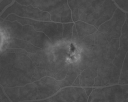
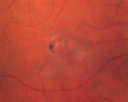
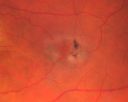
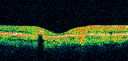
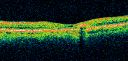
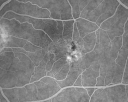
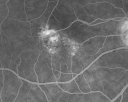
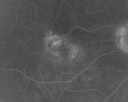
57-year-old woman with a history of decreased vision. The patient reports that her vision has been gradually decreasing in the left more so than the right eye. She reports that she has increased waviness and an increase in the number and volume of blind spots over the past several months. She has a history of idiopathic juxtafoveal telangiectasis. The patient has not had treatment for her condition. She has no history of ophthalmic laser, surgery or trauma. She reports good vision as a child and young adult, but she has been fighting this condition for at least six or eight years. Systemically she has a history of nodular vasculitis and hepatitis. She has had hypothyroidism, skin rashes and ulcers. Family history is negative for retinal detachment or blindness of unknown cause. She does have a family history of liver disease. She smokes one pack per day and takes no ophthalmic medications. A complete history and review of systems is recorded in the chart. OPHTHALMIC EXAMINATION: Visual acuity without correction 20/50 OD and 20/60 OS. IOP: 16 OD and 17 OS. SLIT LAMP EXAMINATION: Biomicroscopy reveals a quiet anterior segment with trace nuclear sclerosis OU. Anterior vitreous is well-formed. POSTERIOR SEGMENT EXAMINATION: Shows a clear view with no PVD in either eye. C/D ratio is 0.2 OU. Large retinal vessels show normal retinal arterial and venous caliber. There are a few microaneurysms within the areas of pigmentary hyperplasia and atrophy in the temporal macula in both eyes. These are associated with telangiectatic small vessels. There appears to be some grayish thickening of the intraretinal tissue in the left more so than the right eye. EXTENDED OPHTHALMOSCOPY: The retinal periphery is flat and intact with no tears, breaks or detachments. OCT SCAN: The OCT examination shows compact neurosensory tissue with hyperreflectivity corresponding to the area of pigment in the right eye on the line scans. The left eye has minimal intraretinal cystic change with hyperreflectivity associated with the pigment in the left eye. FLUORESCEIN ANGIOGRAPHY: Fluorescein angiography of the left eye is transit. Arm to eye time and AV transit time is normal. There is early hyperfluorescence as the dye moves through areas of RP atrophy and transmits. There are microaneurysms with light up in the transit phases. As the study progresses there is moderate leakage from the microaneurysms associated with the area of hyperpigmentation in the temporal macula in the left eye. The right eye has similar, but less severe leakage. IMPRESSION: 1. IDIOPATHIC JUXTAFOVEAL TELANGIECTASIS TYPE 2 2. MILD MACULAR EDEMA ASSOCIATED WITH JFT – LEFT EYE 3. CATARACTS – BOTH EYES, MILD 4. HISTORY OF VASCULITIS WITHOUT EVIDENCE OF INTRAOCULAR INFLAMMATION 5. SMOKING DISCUSSION: The patient and I talked about her retinal condition. I explained that there are limited treatment options for idiopathic juxtafoveal telangiectasis type 2. I explained that laser is probably not a good idea, but that we could consider intravitreal Kenalog. I also explained that intravitreal Avastin has emergent literature for her condition. I think that given her phakic status and her very slow progression compared to the notes that she provided from New Jersey, that intravitreal Avastin may be our best treatment option. She is going to think about this option and return in a month or two for reevaluation and consideration of treatment. Of course I recommended that she stop smoking. |
|||||||
|
|
|
|
||||
|
|
|
|
||||
|
|||||||
|
|||||||
57-year-old woman with a history of decreased vision. The patient reports that her vision has been gradually decreasing in the left more so than the right eye. She reports that she has increased waviness and an increase in the number and volume of blind spots over the past several months. She has a history of idiopathic juxtafoveal telangiectasis. The patient has not had treatment for her condition. She has no history of ophthalmic laser, surgery or trauma. She reports good vision as a child and young adult, but she has been fighting this condition for at least six or eight years. Systemically she has a history of nodular vasculitis and hepatitis. She has had hypothyroidism, skin rashes and ulcers. Family history is negative for retinal detachment or blindness of unknown cause. She does have a family history of liver disease. She smokes one pack per day and takes no ophthalmic medications. A complete history and review of systems is recorded in the chart. OPHTHALMIC EXAMINATION: Visual acuity without correction 20/50 OD and 20/60 OS. IOP: 16 OD and 17 OS. SLIT LAMP EXAMINATION: Biomicroscopy reveals a quiet anterior segment with trace nuclear sclerosis OU. Anterior vitreous is well-formed. POSTERIOR SEGMENT EXAMINATION: Shows a clear view with no PVD in either eye. C/D ratio is 0.2 OU. Large retinal vessels show normal retinal arterial and venous caliber. There are a few microaneurysms within the areas of pigmentary hyperplasia and atrophy in the temporal macula in both eyes. These are associated with telangiectatic small vessels. There appears to be some grayish thickening of the intraretinal tissue in the left more so than the right eye. EXTENDED OPHTHALMOSCOPY: The retinal periphery is flat and intact with no tears, breaks or detachments. OCT SCAN: The OCT examination shows compact neurosensory tissue with hyperreflectivity corresponding to the area of pigment in the right eye on the line scans. The left eye has minimal intraretinal cystic change with hyperreflectivity associated with the pigment in the left eye. FLUORESCEIN ANGIOGRAPHY: Fluorescein angiography of the left eye is transit. Arm to eye time and AV transit time is normal. There is early hyperfluorescence as the dye moves through areas of RP atrophy and transmits. There are microaneurysms with light up in the transit phases. As the study progresses there is moderate leakage from the microaneurysms associated with the area of hyperpigmentation in the temporal macula in the left eye. The right eye has similar, but less severe leakage. IMPRESSION: 1. IDIOPATHIC JUXTAFOVEAL TELANGIECTASIS TYPE 2 2. MILD MACULAR EDEMA ASSOCIATED WITH JFT – LEFT EYE 3. CATARACTS – BOTH EYES, MILD 4. HISTORY OF VASCULITIS WITHOUT EVIDENCE OF INTRAOCULAR INFLAMMATION 5. SMOKING DISCUSSION: The patient and I talked about her retinal condition. I explained that there are limited treatment options for idiopathic juxtafoveal telangiectasis type 2. I explained that laser is probably not a good idea, but that we could consider intravitreal Kenalog. I also explained that intravitreal Avastin has emergent literature for her condition. I think that given her phakic status and her very slow progression compared to the notes that she provided from New Jersey, that intravitreal Avastin may be our best treatment option. She is going to think about this option and return in a month or two for reevaluation and consideration of treatment. Of course I recommended that she stop smoking.